Triathlon Race Prep: Training, Packing, Travel, and Race Day
Comprehensive tips for both first-time and advanced athletes (and everyone in-between!)
 Pre-Race Training and General Advise Pre-Race Training and General Advise
-
This isn’t really a strategy, but I just want to start off by saying that you don’t have to start this sport with a full Ironman!! If you’re new to triathlon, have some fun with it and go do a sprint with some (GGTC) friends. You’ll learn a lot and have a great day... and can go get lunch afterwards instead of suffering out on the pavement for an entire day!
- Practice with your exact race-day setup: bottles, nutrition, spare CO2 and tube, everything. You won't drop bottles or nutrition in a race if you’ve trained with them and learned how to properly secure items.
- Practice riding one handed. Once you are comfortable riding with your right hand free, practice grabbing on-course nutrition.
- Training and practicing with a group (for instance, GGTC?) is one of the best ways to enjoy not just the race experience, but the months of prep leading up to it.
-
The bike leg is typically the longest part of a triathlon, so good fitness can shave the most minutes off your finish time, but the run leg has the biggest time (and emotional) difference between a "good day" and a "bad day".
-
[Advanced] If you’re a person who does not typically shave your legs, or you haven’t done so in a while, don’t save it for right before bed the night before the race. A "pre-pass" with a buzzer is needed before going in with a razor if you have long hair. I’ve seen too many guys up late before an early race sitting in a mess of partially shaved leg hair in a hotel bathroom shower.
️ ❗ Raceday Morning
-
Get up earlier than you strictly need to. It will give your body more time to process breakfast and caffeine.
-
Go for a little jog before leaving home for the race site, as 1.) inevitably things are incredibly chaotic at the race site so warm-ups often get forgotten; and 2.) the chance to get the GI tract moving as much and as early as possible.
-
Bring a gel and some water/drink to the start area: you don’t want to be eating/drinking your race nutrition before the race even starts. This means generally preparing 3-4 bottles the night before: 2-3 for the bike, plus one to sip on before the race. This should also be something with sugar and salt in it. Pop a gel right before the race.
-
Put your timing chip on at home, and never take it off. Tuck it under your wetsuit leg so there’s no chance it gets kicked off during the swim.
-
Bring Toilet Paper for morning Porta-Potties. They tend to run out at rather inconvenient times. Getting your system "cleared out" before starting the race is crucial to avoiding gut drama later. Just ask Taylor Knibb.
️  General Transition Tips General Transition Tips
- It's a lot easier to drop a minute off a transition time than it is to drop a minute off a race time.
- Transition Time = (Time it takes to do thing) x (Number of things you need to do)
-
Do Things Faster
- Generally speaking, it's better to do one thing quickly than two things slowly.
- Practice Makes Perfect!
- Smooth is fast. Be purposeful, not rushed.
-
Do Fewer Things
-
Minimize the amount of stuff that you're doing, whether it's digging through your stuff, or putting on gear.
-
Use quick laces, group and organize your gear, put your hat and race belt on while running, etc.
- For folks with long hair, make sure you have a raceday hair plan that is compatible with your helmet.
- [Advanced] Remember your exact transition rack landmarks. You can sometimes leave something high-visibility (if allowed) to mark your area, or use a highlighter on your bag and/or race number. Race Brain sometimes has trouble finding your bike in a sea of bikes during the chaos of raceday. Do a literal walk-through of the transition area to trace the path you will take on raceday.
- [Advanced] Pair and calibrate power meters and heart-rate monitors in the morning. Don’t leave your bike computer on the bike overnight. The cold temperature can reduce device battery life or make start-up slow.
 Swim Swim

- Get to the starting corral early enough to get a good position, especially if you’re a competitive swimmer. It is common to “overseed” yourself by some amount, especially in Ironman-branded events. Expect to be tightly packed, shoulder-to-shoulder, with many other people before you start.
- Wear your watch under your wetsuit so it doesn’t get kicked off. Expect contact during the swim. In the words of one veteran triathlete, "Be ready for Battle" so you are less shocked when you catch an accidental elbow or a foot.
- Practice in open-water. Really. You want to be confident breathing in adverse conditions, including choppy water, winds, and the mass of flailing triathletes when going around the buoys.
- Match goggle tint to conditions: clear for fog/dark, mirrored for sunrise glare.
- [Advanced] Use Body Glide on your arms/feet for faster wetsuit removal.
- [Advanced] Pack an extra pair of goggles (leave with your morning clothes bag) in case a friend forgets or you somehow snap yours - they’re an irreplaceable item on race day morning!
1️⃣ Transition 1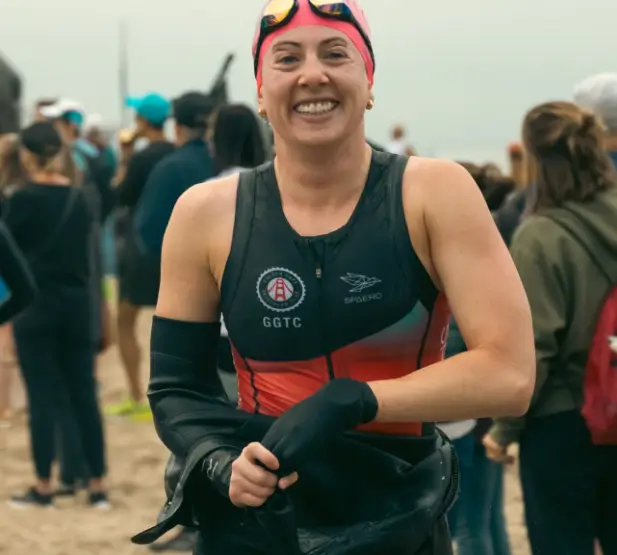
- When you get out of the water, unzip your wetsuit and peel it off your shoulders down to your hips for the T1 run. Hold your cap and goggles in your hand. You can do this while running.
- Keep a bottle of water in your T1 bag to wash off sandy feet.
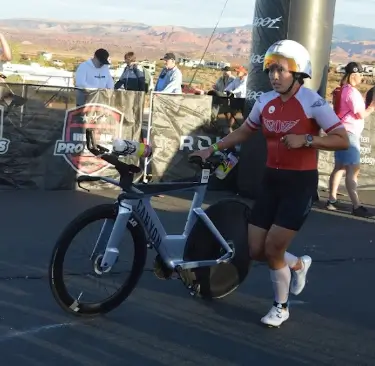
- [Advanced] Run while holding your bike by the seat - it’s marginally faster if you practice.
- [Advanced] Flying mounts require proper setup, using rubber bands to hold your shoes in the proper orientation. Do not attempt unless you are very confident that you won’t faceplant.
 Bike Bike
- Start in the correct gear for the initial course layout. Immediate punchy hill? Be in a lighter gear!
-
Aid Stations
- Slow down and plan a path to ride through the aid stations. Shout out what you’re looking for and volunteers can help direct you to that product.
- If you're not grabbing anything, check behind you, pull left, and ride through. Watch out for athletes cutting back over unexpectedly.
- If you're going to grab something, get into a position where you have a bit of clear “runway” ahead since you don't want to brake while grabbing a bottle. Have your hand out early and make eye contact so the volunteer knows you want one.
- Crashes can happen here very easily since athletes do not always shoulder check when cutting across the road at an aid station…
- Uphill grabs are easier due to slower speeds but many courses don’t have this opportunity
- Initial bottles should be ones you don’t mind tossing.
- Have a place on your bike to put a bottle if you grab it, or know that you need to discard it in the trash zone. Stuffing a bottle down the jersey is not allowed.
- Have a fueling strategy and stick to it. The bike is the most important one to get right since you still have the run to go. Pack extra - you will never regret having more nutrition than you use, especially if you drop something during the race.
- [Advanced] Plan your initial bottle strategy around on-course offerings (carb bottles vs electrolytes). Electrolytes become more important the hotter the race, but carbohydrates can be easily consumed via liquids and salts via tablets or on-course bottles. You should at least have a general idea of how much you sweat and try to replenish those salts. A little math before the race can go a long ways towards avoiding cramping!
- [Advanced] Know the course profile + your personal target power zones. bestbikesplit.com is a good website for pacing. Try to settle into a consistent effort, power, HR, etc. depending on the course. If the course is a bit hillier, it's usually OK to run a higher effort/power/HR on a climb and use the downhill to recover, but practice this before the race to have a sense of what your recovery is. Ability to recover is not the same as your Functional Threshold Power (FTP).
- [Advanced] Having and practicing a good Time Trial (TT) position really helps, but also don't be too afraid to go out of the saddle, especially when aero matters less, for instance on climbs to give your body a little break. Overall, switching position up periodically can help you stay fresher throughout the race and avoid cramping
- [Advanced] Treat riding in aero bars as a skill. Practice in wind, on rolling hills, in corners, while making bottle adjustments, etc.
- [Advanced] In the last mile or two, try to increase your cadence a bit. This can help with getting your legs ready for the higher turnover of the run.
2️⃣ Transition 2
- Know where the dismount line is and be careful with your speed. Don't slow down in the miles directly preceding the transition, but do be careful since in many courses the roads are narrower and people tend to clump up.
- Be careful at the dismount line as it tends to bunch and people struggle with Bambi Legs.
- [Advanced] Quick laces = the easiest 30 seconds you’ll ever save.
 Run Run
- Start slower than you think - your legs may lie to you about how fresh they are at first, only to rudely remind you at mile 10. Have a rough target pace in your head and avoid going dramatically faster. Settle down over the course of the first mile, and re-evaluate your pace at about 60-75% of the run.
- Run the tangents - courses are measured from inner corners; why run extra?
- Stay ahead of heat: ice + water early saves minutes later.
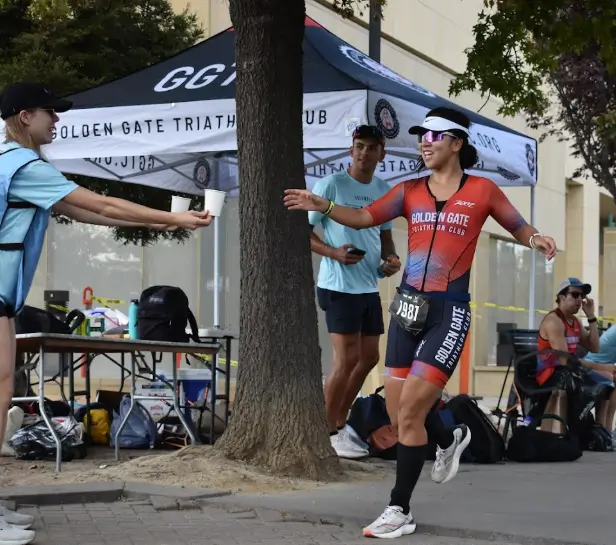
- Make eye contact with the volunteers at aid stations and reach out with a hand to show that you are going to grab from them. Shout out what you’re looking for and volunteers can help direct you to that product. These are volunteers, so the quality of handoffs varies quite a bit; make it as easy as possible for them to help you - not everyone learned from the well-oiled GGTC Aid Station Machine!
- Don't think you need to swallow an entire gel all at once and bomb your stomach. If you grab a gel, you can run with it and slowly ingest it and toss at the next available opportunity.
- [Advanced] The “Pinch & Sip” method of drinking from water cups can help to make sure you get it into your mouth without splashing too much over your face as you run and drink at speed.
- [Advanced] A disposable bottle with electrolytes can be useful to start the run. A plastic bottle (i.e. smart water bottle, or something you are comfortable holding and running with), can be fashioned into a cheap sports bottle with a piece of duct tape. Voila! You now have a $1 sports bottle and can ditch it when you don't want it anymore.
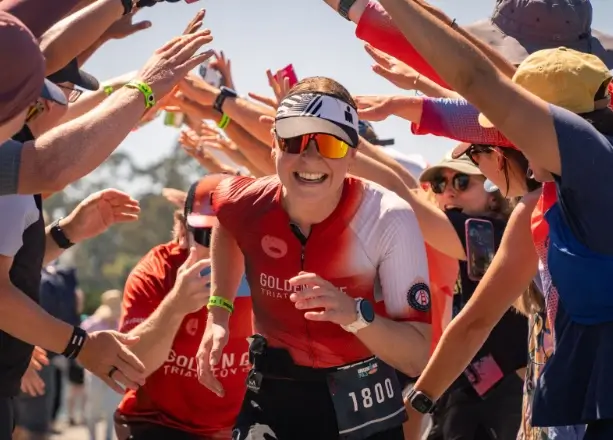
- Smile for the cameras throughout the course - smiling releases endorphins, plus good race photos are always worth it.
- Don’t stop your watch at the finish line - crop your Strava later and keep your finish-line photos perfect!
 Race Packing Race Packing
- Practice being Santa: Make a list. Check it twice.
- Ironman races tend to give out lots of swag so don’t overpack on the outbound, you’ll be coming back with more stuff than you leave with.
✈️ Packing Your Bike for a Flight
- Practice a full teardown, packing, & rebuild using only the tools you’ll travel with.
- Carry-on any irreplaceable raceday items: trisuit, pedals, bike computer, bike/run shoes.
- Use bubble wrap or similar soft packing materials to pad the frame, brake levers, shifters, chainrings, etc. Zip-tie anything that can move or rub until it doesn’t.
- Remove rear derailleur + brake rotors. This is actually pretty easy, and massively reduces damage risk during travel.
- [Advanced] Store small parts and tools in a puncture-resistant bag. Write contents on the outside as a mini-packing list to make sure you don’t leave anything behind.
- Examples: Hex wrenches, seatpost clamps, Di2 wire tool, electrical tape, CO₂ nozzle, pedals, chain clipper.
- Warning: Chain quick links last about 3-8 uses before they wear out. Have a backup for raceday, or use them sparingly.
- Tape loose Di2 cables after unplugging them so they don’t fall back into the frame. You’re here to race, not to go cable fishing!
- Place cardboard between hydraulic brake pads so they can’t be squeezed shut unintentionally.
- TSA doesn’t care about Di2 batteries. CO₂ is technically not allowed in the plane, and you risk losing PreCheck / Global Entry privilege along with a fine if caught...weigh the risks yourself. Mini electric pumps are becoming fairly ubiquitous and avoid this problem.
- An AirTag in the frame can be worth its weight in gold if your bike gets lost.
- Take a photo of your packed case (open, with padding visible) in case you need to press damage claims.
- [Advanced] Bring your own maintenance supplies so that you aren’t reliant on raceday mechanics or unfamiliar bike shops
- Rotor straightener, extra derailleur hanger, mini bleed kit, pump/inflator suited to your wheels.
- Local bike shops may have extra brake pad spacers that they’ll give away before your travels.
- Coordinate tools within any group travel to minimize duplicates.
🎒 General Travel Tips
- Don’t forget to compare airline bike fees. Some carriers treat it as a normal checked bag; others charge $100–300. Factor this price into the total cost of travel. International flights sometimes come with a free checked bag; this can usually be your bike.
- Prioritize direct flights whenever possible; otherwise allow 2+ hour layovers for bike transfer.
- Flying into a small airport for a big race = higher risk of your bike not making it. Buffer your travel time, or fly into a major hub and drive.
- If your luggage (incl. bike) is delayed, airlines owe you $75 to $100 per day as reimbursement for essentials. (Note: Ironman Expo gear counts as “essentials!”)
- Returning to the US: TSA fully unpacks bikes at your first domestic stop. You can help to prevent damage by underpacking your case to avoid TSA repacking carnage (and having to stand there helplessly watching two agents bodyslam your poor baby to get the case to close).
- Or, better yet, try to fly directly back to your final domestic destination.
- Driving with an external rack? Remove disc wheels - they act like sails.
🍝 Nutrition
Don't consume fiber for ~36 hrs prior to the start of a race (i.e. lunch two days before raceday). Healthy gut "transit time" is about 24 hours, so this gives yourself enough time to avoid stopping to use the toilet during the race. Fiber also slows the absorption of carbs into the lower intestine which is how you'll be fueling on raceday. Practice your race day morning breakfast before long training rides. Keep it simple: ~100g of carbohydrates (i.e. 2 bagels and some simple fruits) works great for most. You don't need protein on raceday. -
[Advanced] Train your gut to take in 90–120 g carbs/hr during low-to-medium intensity, Z2/Z3 sessions.
Questions? Check out the Slack channel #race-strategy for even more detailed discussion!
|
|
